
At Home · Published October 20, 2026
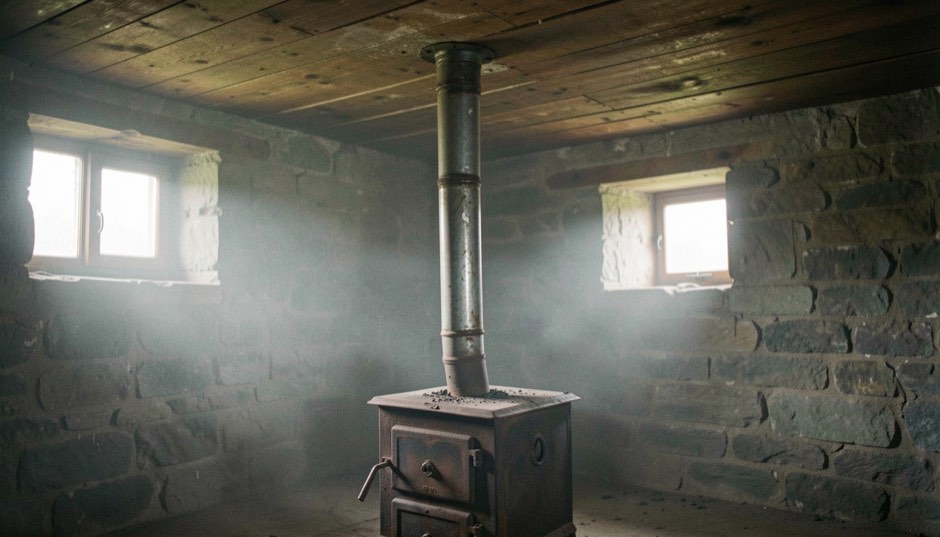
Short answer: carbon monoxide can bend perception, but current medical references describe it mainly through confusion, impaired judgment and headaches, not as a reliable cause of visions. The famous haunted house case is real and has a primary source. The Washington ophthalmologist William H. Wilmer printed a family's account in the American Journal of Ophthalmology in February 1921: from November 1912, a household in a rented house heard footsteps and bells and saw figures until a defective furnace was found pouring carbon monoxide into the rooms.
The case is worth reading in the original, because popular versions blur its dates, add drama and drop the details that make it useful. Set beside current guidance, it does the job it does best: it reminds a household to check the air before settling on an explanation.
What does the original 1921 report say?
The paper is "Effects of Carbon Monoxid upon the Eye" by W. H. Wilmer. He read it before the Ophthalmic Section of the College of Physicians in Philadelphia on October 21, 1920, and it appeared in volume 4, number 2 of the American Journal of Ophthalmology, pages 73-90. The issue is digitized, and the Internet Archive scan of the February 1921 issue lets anyone read the account in full. Wilmer was an eye specialist, and his real subject was the optic nerve. The haunted house enters the paper as Case 1, a long account written by a patient's mother, identified only as Mrs. H., while the events were still fresh in her mind.
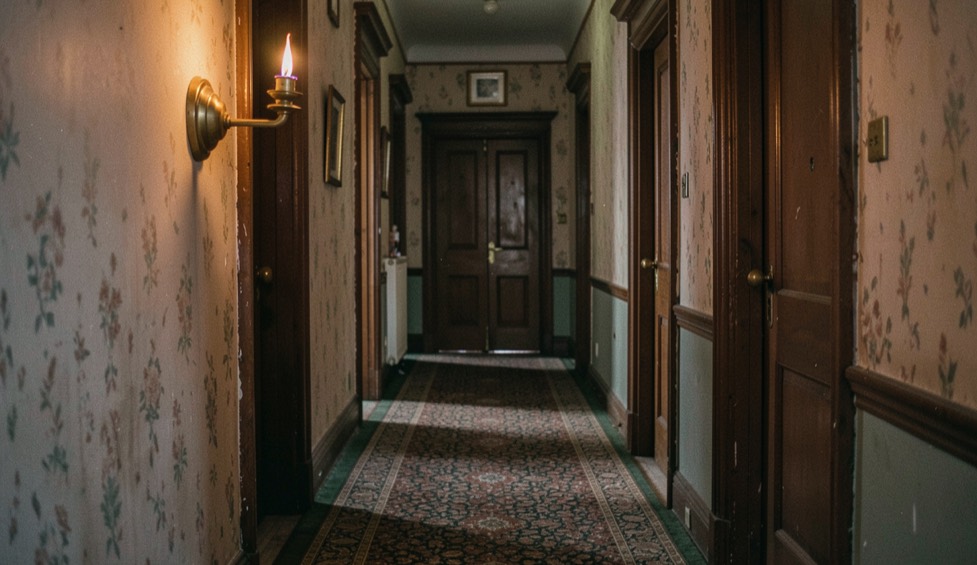
Her account gives a precise setting. The family's town house burned near the end of October 1912, so they rented a furnished house for the winter. It was large and high-ceilinged, built about 1870, out of repair, unoccupied by its owners for ten years, heavily carpeted and lit by gas, with no electricity. They moved in on November 15. On the second day the furnace, a combined hot-air and steam unit thirty or more years old, broke down and needed new parts. The report never names the town.
What did the family hear and see?
Within days, Mrs. H. and her husband, G., felt low in a house she described as overpoweringly quiet. Then the episodes began. Most of them happened at night or on waking:
- footsteps in an empty room overhead, and later heavy steps going down a staircase behind a bedroom wall, where no staircase existed;
- a doorbell and a telephone that woke G. at night, though neither had rung and no one was at the door;
- the sound of a fire engine stopping nearby, in a street that was quiet and empty when he looked;
- a door slamming close by, and crashes downstairs like pots and pans striking together;
- a feeling of being watched from behind at the dining table;
- a four-year-old, B., insisting that someone had called him, and later screaming about a big fat man;
- the children's nurse waking unable to move while a man and a woman sat on the foot of her bed.
The bodily signs ran alongside the night events: headaches that were worse after rest, weakness, feeling cold in the evenings, children who grew pale and listless and would not eat, and colds that eased outdoors and returned indoors. House plants she had kept for years died. When the family traced the history of the house, they learned that the previous occupants had reported the same footsteps and the same night-time episodes, and, going further back, that almost every earlier occupant had felt ill and seen a doctor without a clear finding.
One detail is rarely retold. Three times, Mrs. H. saw a dark-haired woman in black walking toward her in the dining room. Each time the figure turned into her own reflection in a mirror, and she laughed at the trick of the lights. The report presents that episode as a misreading she caught herself, not as an apparition.
How was the furnace finally identified?
On Saturday, January 18, 1913, G.'s brother told the family he thought they were all being poisoned. Several years before, he had read about a family poisoned by water gas who had suffered curious delusions. The specialist he recommended, called Professor S. in the report, was out of town, so an assistant came at once. He examined the house from top to bottom and found the furnace in very bad condition: combustion was imperfect, and instead of going up the chimney, the fumes were sending carbon monoxide into the rooms. He told the family not to let the children sleep in the house another night. Their physician arrived that afternoon and agreed.
Why do retellings give both 1912 and 1921?
Because both dates are right, for different things. The family lived in the house from November 1912 to January 1913. Wilmer presented the case in October 1920 and published it in February 1921. Some popular versions, including a 2018 Halloween post on the American Lung Association blog, date the case to 1912; others call it the 1921 case after the journal. Both point to the same family and the same furnace.
The medical follow-up is the part most versions leave out, and it is the reason the paper exists. Wilmer examined the boy, B., on January 5, 1917, when he was eight and four years out of the house. His mother said he was the only one in the family with lasting symptoms, including trouble reading. Wilmer found his visual fields much contracted, and in later examinations up to March 1920 he recorded paracentral scotomas, small blind areas near the center of vision. He concluded that the boy was recovering from inflammation of both optic nerves, and that nothing apart from the exposure to a poisonous gas could be found to explain it.
Can carbon monoxide poisoning cause hallucinations?
It can contribute to them, but the honest answer has two layers. In 1921, summarizing the medical writing of his time, Wilmer listed hallucinations of sight and hearing among the signs of chronic exposure, along with headaches, ringing in the ears and flashes of light. Current clinical references are more cautious. The Merck Manual's professional chapter on carbon monoxide poisoning, reviewed in April 2025, ties symptoms to the share of hemoglobin carrying carbon monoxide, called carboxyhemoglobin, and does not list hallucinations as a typical sign:
| Carboxyhemoglobin | Symptoms described |
|---|---|
| 10 to 20% | Headache and nausea |
| Above 20% | Vague dizziness, general weakness, difficulty concentrating, impaired judgment |
| Above 30% | Breathlessness on exertion, chest pain in people with coronary artery disease, confusion |
| Higher levels | Fainting, seizures, severely reduced alertness |
| Usually above 60% | Low blood pressure, coma, respiratory failure, death |
After severe poisoning, the same reference describes delayed neuropsychiatric effects that can appear days to weeks later, including psychosis, dementia, parkinsonism and memory disorders, which may become permanent. Individual case reports in psychiatric journals also describe hallucinations after exposure. So carbon monoxide does not need to produce a vision to produce a haunted house. Confusion, poor judgment and headaches, in a silent house where sleep is already disturbed, give ordinary sounds and shapes plenty of room to be misread.
The timing of the H. family's episodes points the same way. Most happened at night or on waking, and several, such as the nurse who could not move while two figures sat on her bed, match the features of sleep paralysis with a sensed presence. A house that disturbs sleep night after night produces more of those moments.
Which carbon monoxide levels matter in a home?
In air, carbon monoxide is measured in parts per million (ppm). These reference points come from U.S. agencies, and they help when reading a detector display or an inspection report:
| Level | What it marks | Source |
|---|---|---|
| 9 ppm over 8 hours | Outdoor air quality standard | EPA |
| 35 ppm over 1 hour | Outdoor air quality standard | EPA |
| 35 ppm over a work shift | Recommended workplace exposure limit | NIOSH |
| 50 ppm over a work shift | Legal workplace exposure limit | OSHA |
| About 1 to 70 ppm, prolonged | Most people have no symptoms; some heart patients may have more chest pain | CPSC |
| Above 150 to 200 ppm, sustained | Disorientation, unconsciousness and death are possible | CPSC |
| 1,200 ppm | Immediately dangerous to life or health | NIOSH |
Above about 70 ppm, CPSC notes, symptoms become more noticeable as levels stay high. The furnace in the H. family's house was never measured, so the report cannot say where on this scale they were.
What should you do if a house feels haunted and people feel unwell?
Treat the combination as a safety question first. The clues worth taking seriously are several people in the same heated home with flu-like symptoms at the same time, which Merck names as a reason to suspect exposure, headaches that ease outdoors, unusual drowsiness, and night disturbances that began with the heating season or a new appliance.
- If a carbon monoxide alarm sounds, do not search for the source. Go outside, call 911 or the fire department, count heads, and stay out until responders say it is safe. If it sounds again within 24 hours, repeat the steps and have a qualified technician inspect every fuel-burning appliance, as CPSC advises.
- Fit battery-operated alarms, or alarms with battery backup, on every level of the home and outside sleeping areas, away from heating vents and where furniture or curtains cannot cover them.
- Have the heating system, chimney and flue professionally inspected every year.
- If someone needs care, mention possible carbon monoxide. A standard pulse oximeter cannot tell carboxyhemoglobin from normal hemoglobin and reads falsely high; the diagnosis rests on a blood test read with a CO-oximeter.
The stakes are not historical. The CDC reports that each year more than 400 Americans die from unintentional carbon monoxide poisoning not linked to fires, more than 100,000 visit an emergency department and more than 14,000 are hospitalized. It also warns that people who are asleep can die before they notice any symptoms. The household carbon monoxide first check sets out these steps in the order to take them tonight.
What the case does not prove
The H. family account is one household's story, written by a layperson and published by a doctor interested in eyes. It shows that a defective furnace can fill a house with experiences that feel like a haunting, and that a heating inspection, not a ghost hunt, ended the family's search for an explanation. It does not show that every haunted house is a gas leak, and it does not measure how much carbon monoxide anyone breathed. Keep those two things apart, the way a careful record separates what was observed from what was inferred. If the air tests clean, the question stays open, and it can be explored safely.
The case at a glance
- Source: W. H. Wilmer, "Effects of Carbon Monoxid upon the Eye," American Journal of Ophthalmology, vol. 4, no. 2, February 1921, pages 73-90.
- Presented: Ophthalmic Section, College of Physicians, Philadelphia, October 21, 1920.
- Household: Mrs. H., her husband G., three children, the children's nurse, a governess and several servants.
- Period in the house: November 15, 1912 to the inspection of January 18, 1913.
- Cause found: a defective furnace with imperfect combustion sending carbon monoxide into the rooms.
- Follow-up: inflammation of both optic nerves in the son, B., examined from 1917 to 1920.
- Author: William Holland Wilmer (1863-1936), ophthalmologist in Washington, D.C., and from 1925 the first director of the Wilmer Eye Institute at Johns Hopkins.
Questions readers ask
Is the carbon monoxide haunted house story true?
It has a primary source. Mrs. H.'s account of the winter of 1912 to 1913 is printed in W. H. Wilmer's paper in the American Journal of Ophthalmology of February 1921, with his later examinations of her son's eyes. The report withholds the family's name and the town, and nobody measured the gas, so it is a documented account rather than a measured case.
Can low levels of carbon monoxide cause strange experiences?
Low to moderate exposure can bring headache, fatigue, nausea and dizziness, according to CPSC, and tired, aching people misread ordinary night sounds more easily. Clinical references do not list hallucinations as a typical sign of mild poisoning, so a strange experience is a reason to check the air, not a diagnosis.
Will a carbon monoxide alarm pick up a slow furnace leak?
Not always. CPSC says alarms are designed to sound before potentially life-threatening levels are reached, so a low reading may not set one off. The test button checks the circuitry, not the sensor, and alarms have a replacement age. A yearly inspection of the furnace, flue and chimney covers what an alarm cannot.